Posts

Coming to a campus near you: Nuclear microreactors

Image
International Conference on Nuclear Physics  If your image of nuclear power is giant, cylindrical concrete cooling towers pouring out steam on a site that takes up hundreds of acres of land, soon there will be an alternative: tiny nuclear reactors that produce only one-hundredth the electricity and can even be delivered on a truck. Small but meaningful amounts of electricity — nearly enough to run a small campus, a hospital or a military complex, for example — will pulse from a new generation of micronuclear reactors. Now, some universities are taking interest. “What we see is these advanced reactor technologies having a real future in decarbonizing the energy landscape in the U.S. and around the world,” said Caleb Brooks, a nuclear engineering professor at the University of Illinois at Urbana-Champaign. The tiny reactors carry some of the same challenges as large-scale nuclear, such as how to dispose of radioactive waste and how to make sure they are secure. Supporters say those i...

Protons may be stretchier than physics predicts

Image
  International Conference on Nuclear Physics  The subatomic particles are built of smaller particles called quarks, which are bound together by a powerful interaction known as the strong force. New experiments seem to show that the quarks  respond more than expected to an electric field pulling on them , physicist Nikolaos Sparveris and colleagues report October 19 in  Nature . The result suggests that the strong force isn’t quite as strong as theory predicts. It’s a finding at odds with the standard model of particle physics, which describes the particles and forces that combine to make up us and everything around us. The result has some physicists stumped about how to explain it — or whether to even try. “It is certainly puzzling for the physics of the strong interaction, if this thing persists,” says Sparveris, of Temple University in Philadelphia. Such stretchiness has turned up in other labs’ experiments, but wasn’t as convincing, Sparveris says. The stretchine...

The long road to a fusion-powered future

Image
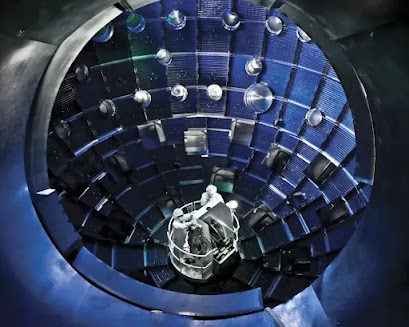
International Conference on Nuclear Physics  The big picture: This week's announcement of a major fusion reaction advance was a demonstration of the physics at the heart of a clean energy source scientists have pursued for decades. But scientific and engineering challenges remain, particularly the development of new materials."It is a long development path but it will accelerate," says Nigel Woolsey, a professor of physics at the University of York. He estimates scientists could demonstrate a plant that produces fusion energy at scale in 10 to 20 years. Driving the news: Researchers at the National Ignition Facility (NIF) at Lawrence Livermore National Laboratory (LLNL) in California announced they had for the first time produced more energy from a nuclear fusion reaction than the energy put into the reaction, or what's known as ignition. The achievement on Dec. 5 came after decades of work and builds on earlier results . "You can think of it as the Moore's L...

Nuclear physics adopts machine learning

Image
  International Conference on Nuclear Physics To assist them save time and money, scientists have started utilizing new tools provided by machine learning. Nuclear physics has experienced a flurry of machine-learning initiatives going online during the past few years, and numerous papers have been published on the topic. “It was essential to record the work that had been completed. In order for people to better comprehend the variety of activities, we genuinely wish to raise awareness of the use of ML in nuclear physics, “Amber Boehnlein remarked. Because it combines and analyses key work that has been done in the field thus far, Boehnlein believes that the essay will act as a roadmap for future studies as well as an instructional resource for people who are intrigued by the subject. Boehnlein went to a workshop on artificial intelligence in March 2020 at Jefferson Lab. They were inspired to move forward after publishing a follow-up report. And including 15 other colleagues who cov...

Atomic Radius Trend

Image
International Conference on Nuclear Physics The atomic radius trend describes how the atomic radius changes as you move across the periodic table of the elements. In general, the atomic radius of an element tends to increase as you move down an element group in the periodic table. What Is Atomic Radius? Atomic radius refers to the size of the atom . Yet this value isn’t as easy to pin down as you might think. First of all, it’s important to be aware of the fact that although the term atomic radius is used to refer to an atom’s size, there isn’t an agreed-upon definition for this value. Various methods of measuring atomic radius are used, including the ionic radius, the metallic radius, the covalent radius, and the Van der Waals radius. “I must confess I am jealous of the term atom; for though it is very easy to talk of atoms, it is very difficult to form a clear idea of their nature.” — Michael Faraday Ionic radius refers to the measure of an atom’s ion when in a crystal lattice, and ...

Directly Challenging Our Understanding of Nuclear Force: Scientists Discover Strongest Isospin Mixing Ever Observed

Image
Isospin mixing is a concept in nuclear physics that refers to the symmetry in atomic nuclei induced by the nearly identical properties between protons and neutrons. Researchers from the Chinese Academy of Sciences’ Institute of Modern Physics and their collaborators have identified the most significant isospin mixing observed in beta-decay experiments, directly challenging our current understanding of the nuclear force. The findings were featured as an Editors’ Suggestion in the journal Physical Review Letters. In 1932, Werner Heisenberg, a Nobel Prize laureate, introduced the idea of isospin to explain the symmetry in atomic nuclei resulting from the similar properties of protons and neutrons. Isospin symmetry is still widely accepted today. However, isospin symmetry is not strictly conserved due to proton-neutron mass difference, Coulomb interaction, and charge-dependent aspects of nuclear force. Such asymmetry leads to fragmentation of the allowed Fermi transition to many states v...

Breakthrough in nuclear fusion energy announced

Image
A major breakthrough has been announced by US scientists in the race to recreate nuclear fusion. Physicists have pursued the technology for decades as it promises a potential source of near-limitless clean energy. On Tuesday researchers confirmed they have overcome a major barrier - producing more energy from a fusion experiment than was put in. But experts say there is still some way to go before fusion powers homes. How does nuclear fusion work? The experiment took place at the National Ignition Facility at the Lawrence Livermore National Laboratory (LLNL) in California. LLNL director Dr Kim Budil said: "This is a historic achievement… over the past 60 years thousands of people have contributed to this endeavour and it took real vision to get us here." Nuclear fusion is described as the "holy grail" of energy production. It is the process that powers the Sun and other stars. It works by taking pairs of light atoms and forcing them together - this "fusion...